

Arthroscopy in Kukatpally, Hyderabad
Arthroscopy is a minimally invasive procedure used to examine and, when appropriate, treat problems inside a joint. This guide explains common types of arthroscopy, when it may be considered, how the procedure is performed, recovery and potential risks.
What is arthroscopy?
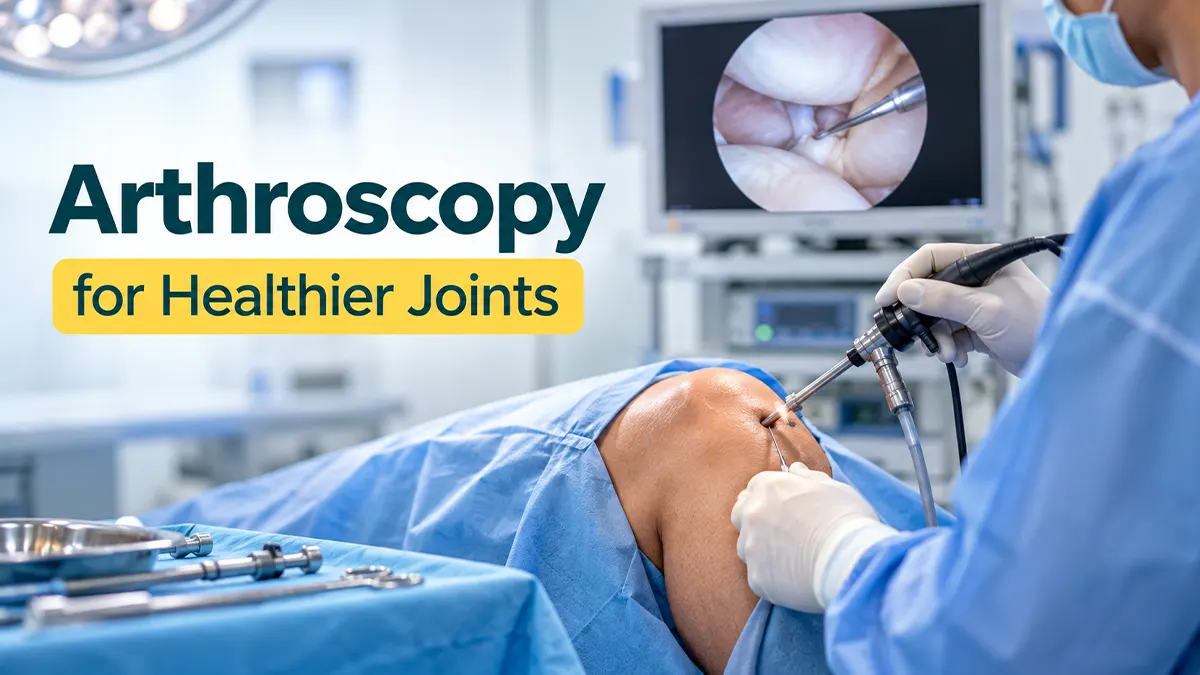
Arthroscopy is a minimally invasive joint procedure in which an orthopedic surgeon uses a small camera called an arthroscope to examine the inside of a joint. Through small incisions, selected joint problems can also be treated using specialized surgical instruments. It is commonly used for conditions affecting the knee and shoulder, as well as other joints when clinically appropriate.
Arthroscopy: Uses, Types and Joint Conditions
Arthroscopy allows an orthopedic surgeon to inspect the structures inside a joint through small incisions. It may be used when a person has persistent joint symptoms and the clinical assessment and imaging findings indicate that an arthroscopic procedure could provide useful diagnosis or treatment.
Arthroscopy is used in several joints, including the knee, shoulder, hip, ankle, elbow and wrist. The exact approach depends on the joint involved, the suspected condition and the treatment required.
When may arthroscopic surgery be considered?
Arthroscopy is not required for every joint problem. An orthopedic evaluation may consider it when symptoms, examination and imaging suggest a condition that can be appropriately addressed with an arthroscopic procedure.
- Meniscus or cartilage injuries of the knee.
- Selected ligament injuries, including some ACL-related procedures.
- Shoulder conditions involving the rotator cuff, labrum or other structures.
- Loose bodies within a joint.
- Selected joint inflammation or damaged tissue requiring surgical assessment.
- Persistent symptoms despite appropriate non-surgical treatment, when surgery is indicated.
Before surgery
Your orthopedic specialist may review your symptoms, physical examination and imaging such as X-rays or MRI. The decision to operate depends on the diagnosis, severity, functional limitation and expected benefit of treatment.
Common types of arthroscopy
Knee Arthroscopy
May be used for selected meniscus, cartilage, ligament and loose-body problems, depending on the diagnosis.
Shoulder Arthroscopy
Can be used for selected rotator cuff, labral, instability and other shoulder conditions.
Other Joints
Arthroscopic procedures may also be performed on the hip, ankle, elbow, wrist and other joints when clinically appropriate.
What happens during arthroscopy?
Before the procedure, the orthopedic team confirms the diagnosis, planned operation and anesthesia approach. Depending on the joint and operation, arthroscopy may be performed using general or regional anesthesia.
The surgeon makes small incisions around the joint and inserts the arthroscope, which transmits images to a monitor. If treatment is needed, additional small instruments can be introduced through other incisions to address the identified problem. The incisions are then closed and dressed.
The duration of surgery varies considerably because arthroscopy covers many different procedures. Your surgeon should explain the expected duration, anesthesia, hospital stay and rehabilitation plan for your specific operation.
Potential benefits and limitations
Potential benefits
- Smaller incisions than many open procedures.
- Direct visualization of structures inside the joint.
- Can combine diagnosis and treatment in selected cases.
- May involve less soft-tissue disruption than some open operations.
Important limitations
- Arthroscopy is not suitable for every joint condition.
- Recovery depends on the exact procedure, not simply on the word “arthroscopy.”
- Some conditions are better managed with medication, physiotherapy or another procedure.
- As with any surgery, complications are possible.
What to expect after arthroscopic surgery
Recovery varies according to the joint, the procedure performed and the condition being treated. Some procedures allow relatively early movement, while ligament reconstruction or cartilage procedures may require a longer rehabilitation program.
- Follow the surgeon's wound-care and activity instructions.
- Use prescribed medicines as directed.
- Begin physiotherapy or rehabilitation when advised.
- Increase activity gradually according to the surgical plan.
Contact your doctor promptly if
You develop worsening pain, significant swelling, fever, increasing redness, drainage from the incision, calf swelling or other concerning symptoms after surgery.
Risks and possible complications
Arthroscopy is commonly used as a minimally invasive surgical technique, but it is still surgery and does not eliminate risk. Possible complications depend on the procedure and may include infection, bleeding, blood clots, nerve or blood-vessel injury, stiffness, persistent symptoms or problems related to anesthesia.
Ask your orthopedic surgeon about the risks that specifically apply to your planned procedure and your individual health circumstances.
Arthroscopy vs open joint surgery
| Feature | Arthroscopy | Open Surgery |
|---|---|---|
| Incision | Usually uses small portals around the joint. | Usually requires a larger incision to access the area. |
| Visualization | Uses a camera and monitor to view the joint. | The surgeon accesses the relevant structures directly. |
| Suitability | Useful for selected joint conditions and procedures. | May be necessary when the condition cannot be appropriately treated arthroscopically. |
| Recovery | Varies by procedure and may be shorter for some operations. | Recovery depends on the operation and the amount of tissue involved. |
Arthroscopy in Kukatpally and Hyderabad
People searching for arthroscopy in Kukatpally, KPHB and nearby parts of Hyderabad may need evaluation for knee pain, shoulder problems, sports-related injuries, meniscus or cartilage injuries and other joint conditions. An orthopedic consultation can help determine whether non-surgical care, imaging, arthroscopy or another treatment is appropriate.
When choosing where to undergo a procedure, patients can ask about the surgeon's relevant experience, the exact procedure being proposed, anesthesia arrangements, rehabilitation, expected recovery and potential complications.

Dr. Sandeep
Qualifications: MBBS, MS, M.Ch
Consultation timing: 10 am – 6 pm
The original page identifies Dr. Sandeep as an orthopedic doctor associated with this service. Patients should confirm current availability and appointment details before visiting.
Book An AppointmentFrequently Asked Questions About Arthroscopy
Need an Orthopedic Evaluation?
If persistent joint pain, stiffness or an injury is affecting your daily activities, an orthopedic consultation can help determine the appropriate next step.
+91 9111674111