What is spine surgery?
Spine surgery includes operations used to treat selected conditions involving the vertebrae, discs, spinal nerves or spinal cord. The procedure depends on the specific diagnosis.


+91 9111674111
+91 9100001201
Orthopedics
Spine surgery may be considered for selected spinal conditions when symptoms, examination and imaging indicate that an operation could help. This guide covers diagnosis, discectomy, minimally invasive procedures, recovery and risks.
Surgery is generally considered after clinical evaluation when a specific spinal problem is identified and the expected benefits of surgery outweigh its risks.
Spine surgery is an operation used to treat selected conditions affecting the spine, discs, nerves or spinal cord. It may be considered for problems such as certain herniated discs, spinal stenosis, instability or nerve compression when symptoms persist or when there is a neurological or structural indication for surgery.
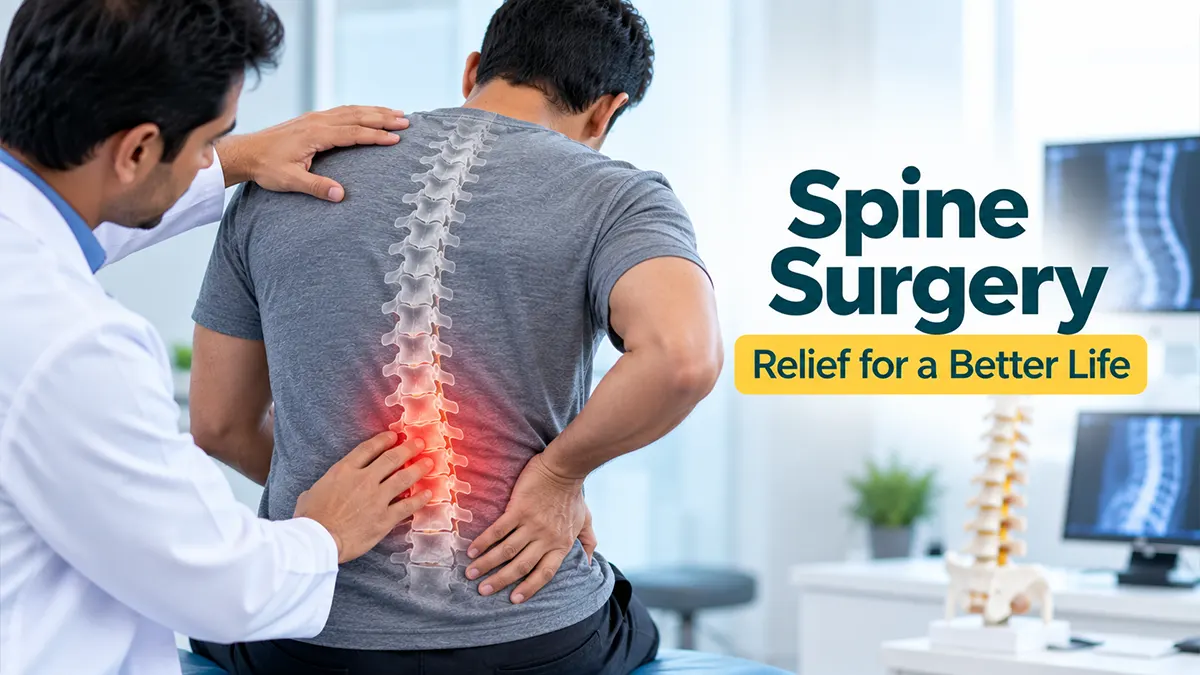
Spine surgery includes different procedures designed to address specific problems involving the vertebrae, discs, spinal nerves or spinal cord. The appropriate operation depends on the diagnosis rather than on back pain alone.
Procedures can range from decompression operations such as discectomy or laminectomy to stabilization or fusion procedures. Some selected operations can be performed through minimally invasive approaches.
Depending on the diagnosis, surgery may be considered for:
New difficulty starting urination, inability to pass urine, loss of bladder or bowel control, numbness around the genitals or bottom, or rapidly developing significant weakness needs emergency hospital assessment. Do not wait for a routine appointment. New walking difficulty or hand clumsiness with neck symptoms also needs urgent assessment.
Assessment usually begins with a medical history and physical examination. The clinician may evaluate pain distribution, movement, muscle strength, reflexes and sensation and look for signs of nerve involvement.
The procedure is selected according to the underlying spinal problem. Examples include:
| Procedure | Purpose |
|---|---|
| Discectomy | Removes part of a herniated disc that is compressing a nerve when surgery is indicated. |
| Laminectomy | Removes part of the vertebral bone to create more space around neural structures in selected conditions. |
| Spinal fusion | Joins selected vertebrae to provide stability when fusion is clinically appropriate. |
| Endoscopic or minimally invasive spine surgery | Uses smaller access points for selected procedures and suitable spinal conditions. |
Endoscopic spine surgery uses a small access pathway and a camera-based system to reach the targeted spinal area. When appropriate for the diagnosis, specialized instruments can be used to remove disc material or decompress a nerve.
The exact technique, anesthesia, incision size, monitoring and hospital stay vary according to the procedure and the patient's condition. Not every spinal problem is suitable for an endoscopic approach.
Selected minimally invasive procedures use smaller incisions than conventional open approaches.
Some approaches are designed to reduce disruption to surrounding muscles and soft tissues, depending on the procedure.
Selected patients may experience less postoperative discomfort or a shorter recovery compared with certain open procedures, although results vary.
Minimally invasive surgery is not automatically better for every diagnosis. The surgical approach should be chosen according to the patient's anatomy, condition and treatment goals.
Recovery depends on the operation, underlying diagnosis, general health and whether neurological symptoms were present before surgery. Some patients return to light activities relatively quickly, while more complex operations require longer rehabilitation.
Like other operations, spine surgery has risks. Depending on the procedure, these may include infection, bleeding, blood clots, nerve injury, dural tear or cerebrospinal-fluid leak, persistent pain, recurrent disc problems, anesthesia-related complications and complications related to implants or fusion.
The surgeon should explain procedure-specific risks, expected benefits, alternatives and recovery before surgery.
Spine surgery includes operations used to treat selected conditions involving the vertebrae, discs, spinal nerves or spinal cord. The procedure depends on the specific diagnosis.
No. Many causes of back pain are managed without surgery. Surgery is considered only when a specific condition and clinical findings make an operation appropriate.
A discectomy removes part of a herniated or damaged disc that is compressing a nerve when surgery is clinically indicated.
Minimally invasive spine surgery uses smaller access points and specialized instruments for selected spinal procedures. It is suitable only for certain diagnoses and patients.
Diagnosis may involve a medical history, physical examination and, when appropriate, imaging such as MRI or CT. The need for imaging depends on the symptoms and clinical findings.
Recovery varies by the operation, diagnosis and individual health. Some procedures have shorter recovery periods, while complex operations may require longer rehabilitation.
Possible risks include infection, bleeding, nerve injury, cerebrospinal-fluid leak, persistent or recurrent symptoms and anesthesia-related complications. Risks vary by procedure.
Rehabilitation is often part of recovery, but the timing and type of physiotherapy depend on the operation and the surgeon's instructions.
Yes, selected spinal procedures can be performed using an endoscopic approach. Suitability depends on the diagnosis, anatomy and procedure required.
New bladder or bowel dysfunction, difficulty passing urine, groin or bottom numbness, or rapidly worsening major weakness needs emergency assessment for possible serious nerve compression. Seek care immediately rather than waiting for a routine consultation.
Medical information note: This page provides general educational information and does not replace an examination, diagnosis or individualized treatment plan from a qualified healthcare professional.
If you have persistent back or neck symptoms, radiating pain, numbness or weakness, seek an appropriate clinical assessment. Surgery is only one option and depends on the diagnosis, examination and discussion of alternatives.
Tarnaka Spine Consultation InformationPatient information: NHS: lumbar decompression · AAOS: spinal fusion · NHS: slipped disc.
Find Our Kukatpally and Tarnaka Branches
H.No 15-24-212, MIG-212, Rd Number 1, K P H B Phase 1, Kukatpally, Hyderabad, Telangana 500072
H.No:-12-5-30, WhiteHouse, Moula Ali Rd, South Lalaguda, Tarnaka, Secunderabad, Telangana 500017