
-
 Kphb Branch
+91 9111674111
-
Tarnaka Branch
+91 9100001201
- Book Appointment
+91 9111674111
+91 9100001201
Vascular Surgery
Symptoms, duplex ultrasound, treatment options, recovery and warning signs—explained in a concise patient guide.
Consider vascular evaluation when visible varicose veins are associated with persistent aching, heaviness, swelling, itching, skin changes, bleeding or a non-healing venous ulcer. Sudden one-sided leg swelling or chest symptoms require urgent assessment rather than a routine vein appointment.
Duplex ultrasound is commonly used to identify venous reflux and map veins when treatment is being planned. Current NICE and vascular-surgery guidance supports duplex assessment for treatment planning.
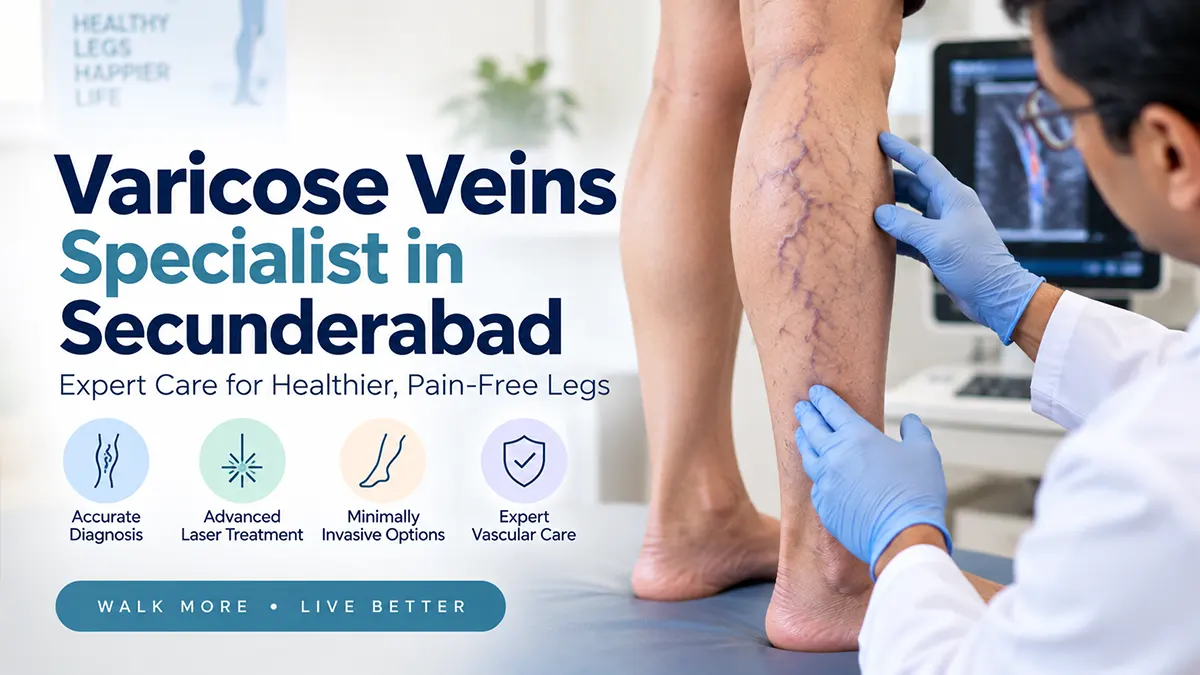
Varicose veins are enlarged, twisted superficial veins that commonly appear in the legs. They develop when venous valves do not work effectively, allowing blood to pool and venous pressure to rise.
Not every visible vein needs a procedure. Management depends on symptoms, examination, vein anatomy, reflux on ultrasound, complications and patient goals. Evidence-based guidelines describe conservative and interventional options for appropriately selected patients.
The uploaded source identifies Dr. Puneeth Joopalli as a vascular and endovascular surgeon at My Health Hospitals, Tarnaka, and lists MBBS, MS General Surgery and DNB Vascular Surgery (NIMS).
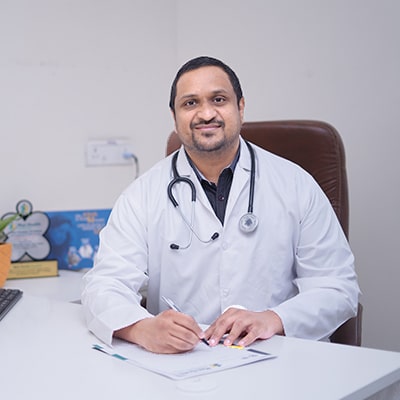
Qualification: MBBS, MS General Surgery, DNB Vascular Surgery (NIMS)
Specialty: Vascular & Endovascular Surgery
Source-listed experience: 15+ years
Source-listed expertise: Varicose veins, EVLT, sclerotherapy, DVT and diabetic foot care
Vascular SurgeryVaricose VeinsDVT CareConfirm current consultation timings and appointment availability directly with the hospital.
Twisted, enlarged veins may appear beneath the skin, commonly on the legs.
Leg aching or heaviness may become more noticeable after prolonged standing.
Venous disease can contribute to swelling, particularly around the ankles.
Chronic venous pressure can be associated with itching and lower-leg skin changes.
Cramps or uncomfortable legs may occur, although these symptoms have many possible causes.
Skin breakdown, venous ulcers or bleeding from a varicose vein should be medically assessed.
Close relatives with varicose veins can increase susceptibility.
Changes in vein walls and valves with age can increase risk.
Increased blood volume and hormonal and mechanical changes can contribute.
Long periods in one position can worsen venous pooling and symptoms.
Excess weight is associated with increased venous pressure and varicose veins.
Previous thrombosis or venous damage can contribute to chronic venous problems.
Good treatment planning starts with identifying which veins are causing abnormal reflux.
A vascular specialist reviews symptoms, previous venous problems, medicines and risk factors and examines the legs.
Duplex ultrasound shows blood flow, reflux and venous anatomy and can help map the veins before treatment.
The appropriate option depends on vein anatomy, symptoms, reflux, complications and patient preference.
| Option | How it works | When it may be considered |
|---|---|---|
| Lifestyle measures | Walking, weight management and avoiding prolonged immobility may help symptoms and general venous health. | Part of overall management, particularly for mild symptoms. |
| Compression | Compression can reduce venous pooling and symptoms in selected patients. | Use depends on symptoms, arterial circulation and the treatment plan. |
| Endovenous laser / thermal ablation | A catheter delivers thermal energy to close an incompetent superficial vein. | Commonly considered when significant truncal reflux is confirmed and anatomy is suitable. |
| Foam sclerotherapy | Ultrasound-guided injection is used to treat selected veins. | Considered when appropriate for the vein pattern. |
| Adhesive closure | A medical adhesive closes a selected superficial vein without thermal energy. | One non-thermal option for appropriately selected patients. |
| Phlebectomy or surgery | Selected superficial veins are removed through small incisions or an operative approach. | May be considered when other approaches are unsuitable or for selected tributary disease. |
Treatment options are guideline-based; individual suitability requires assessment.
Endovenous laser treatment is a minimally invasive form of thermal ablation. A catheter is placed in an affected superficial vein and laser energy is used to close it.
Local anaesthesia is used in appropriate settings. Temporary bruising, tenderness or tightness can occur, and recovery varies.
Guidelines support endothermal ablation for appropriately selected patients with confirmed varicose veins and truncal reflux.
These symptoms can have causes other than uncomplicated varicose veins, including DVT or pulmonary embolism.
Early walking is commonly encouraged after minimally invasive procedures according to clinical instructions.
Temporary bruising, tenderness or tightness can occur after ablation or injections.
Compression may be advised for selected patients according to the procedure plan.
Follow-up allows assessment of treated veins, symptoms and complications.
Timing varies with the procedure and type of work; there is no universal recovery time.
New venous disease can develop over time, so symptom monitoring remains important.
Check appropriate vascular training for the condition being treated.
Ask how venous reflux and affected veins will be assessed.
A specialist should explain conservative and interventional choices rather than promoting one procedure for everyone.
Ask where to go if significant bleeding or severe symptoms occur.
Request an itemised estimate after assessment.
Clarify follow-up arrangements and warning signs before treatment.
The uploaded source identifies My Health Hospitals, Tarnaka, as the practice location for Dr. Puneeth Joopalli. Confirm current appointment availability, services, pricing and insurance arrangements directly with the hospital.
Phone: +91 9100001201
General educational information; treatment decisions require individual assessment.
A vascular specialist evaluates symptoms and vein anatomy, may arrange duplex ultrasound when indicated, and discusses conservative, endovenous, injection-based or surgical options according to the cause and severity.
Consider an evaluation for persistent aching, heaviness, swelling, itching, skin changes, bleeding or a non-healing venous ulcer. Sudden one-sided leg swelling or chest symptoms require urgent assessment.
Varicose veins develop when venous valves do not work effectively, allowing blood to pool and venous pressure to rise. Family history, age, pregnancy, prolonged standing or sitting and excess weight can increase risk.
Common symptoms include visible enlarged veins, aching or heaviness, ankle or leg swelling and itching. Some people have visible veins without significant symptoms.
Duplex ultrasound is commonly used to identify venous reflux, map affected veins and help plan treatment when an intervention is being considered.
Depending on the anatomy and symptoms, treatment may include lifestyle measures, compression when appropriate, endovenous laser or radiofrequency ablation, foam sclerotherapy, adhesive closure, phlebectomy or surgery in selected cases.
EVLT is a form of endovenous laser treatment that uses thermal energy to close an incompetent superficial vein. Suitability depends on the vein anatomy and ultrasound findings.
Endovenous laser treatment uses local anaesthesia, but temporary pressure, bruising, tenderness or tightness can occur. Pain and recovery vary between individuals.
Yes. Many appropriately selected patients can be considered for minimally invasive approaches such as endovenous ablation or sclerotherapy.
Recovery varies by procedure and individual health. Many minimally invasive treatments allow early walking and relatively quick return to routine activities, but the clinician should provide personalised advice.
Compression can reduce symptoms such as aching or swelling in selected patients, but it does not repair faulty venous valves.
Many are not immediately dangerous, but advanced venous disease can be associated with skin changes, bleeding, superficial thrombophlebitis and venous ulcers. Sudden painful swelling needs prompt assessment.
Yes. Venous hypertension can contribute to ankle and lower-leg swelling, especially after prolonged standing. Persistent or sudden swelling should be assessed.
Varicose veins are larger, raised or twisted superficial veins. Spider veins are smaller visible vessels close to the skin. Treatment depends on symptoms, anatomy and goals.
New varicose veins or recurrence can occur because venous disease may involve other veins over time. Follow-up helps with long-term management.
Pregnancy can increase the likelihood of varicose veins because of increased blood volume and hormonal and mechanical changes. Some pregnancy-related veins improve after delivery.
Chronic venous insufficiency is impaired return of blood from the legs, often involving venous valve dysfunction. Symptoms may include swelling, heaviness, skin changes and venous ulcers.
Treatment may be considered when symptoms or complications affect health or daily life, or when there are findings such as skin changes, bleeding or venous ulceration.
Cost varies with diagnosis, vein anatomy, procedure, investigations, facility charges and insurance. A personalised estimate should be provided after assessment rather than using a fixed online price.
The uploaded source identifies My Health Hospitals, Tarnaka, and Dr. Puneeth Joopalli for vascular and varicose-vein care. Confirm current appointment timings, services, pricing and insurance directly with the hospital.
Testimonials are patient-experience content from the uploaded source and are not guarantees of treatment outcome.
“I suffered from varicose veins for over five years and finally visited Dr. Puneeth Joopalli at My Health Hospitals, Tarnaka.”
— Pradeep K.“I had swelling and leg cramps due to varicose veins. Dr. Puneeth Joopalli’s explanation and treatment plan gave me confidence.”
— Deepika Menon“My father underwent varicose vein sclerotherapy with Dr. Puneeth Joopalli. The hospital facilities were modern and the approach was reassuring.”
— Suresh NaiduFind the Best Hospital Near You
H.No 15-24-212, MIG-212, Rd Number 1, K P H B Phase 1, Kukatpally, Hyderabad, Telangana 500072
H.No:-12-5-30, WhiteHouse, Moula Ali Rd, South Lalaguda, Tarnaka, Secunderabad, Telangana 500017