

General Medicine
Viral Fever vs Dengue
Blog
Fever & Infection Guide
Viral Fever vs Dengue: Symptoms, Differences, Test & Warning Signs
Medically reviewed by Dr. Ch. Srujith, General Physician & Diabetologist
Viral fever and dengue can look very similar at the beginning. The safest approach is not to diagnose dengue from one symptom or a platelet count alone, but to consider the illness day, symptoms, exposure risk and appropriate laboratory testing.
QUICK ANSWER
Can you tell viral fever from dengue by symptoms alone? Not reliably in the first few days. Dengue may cause high fever, severe headache, pain behind the eyes, muscle or joint pain, nausea or rash, while respiratory viral illnesses more often cause cough, sore throat or runny nose. Consider testing when dengue is suspected.
What should you remember? Dengue can worsen around the time the fever falls. Severe abdominal pain, repeated vomiting, bleeding, breathing difficulty, extreme weakness or unusual restlessness or sleepiness require urgent medical attention.
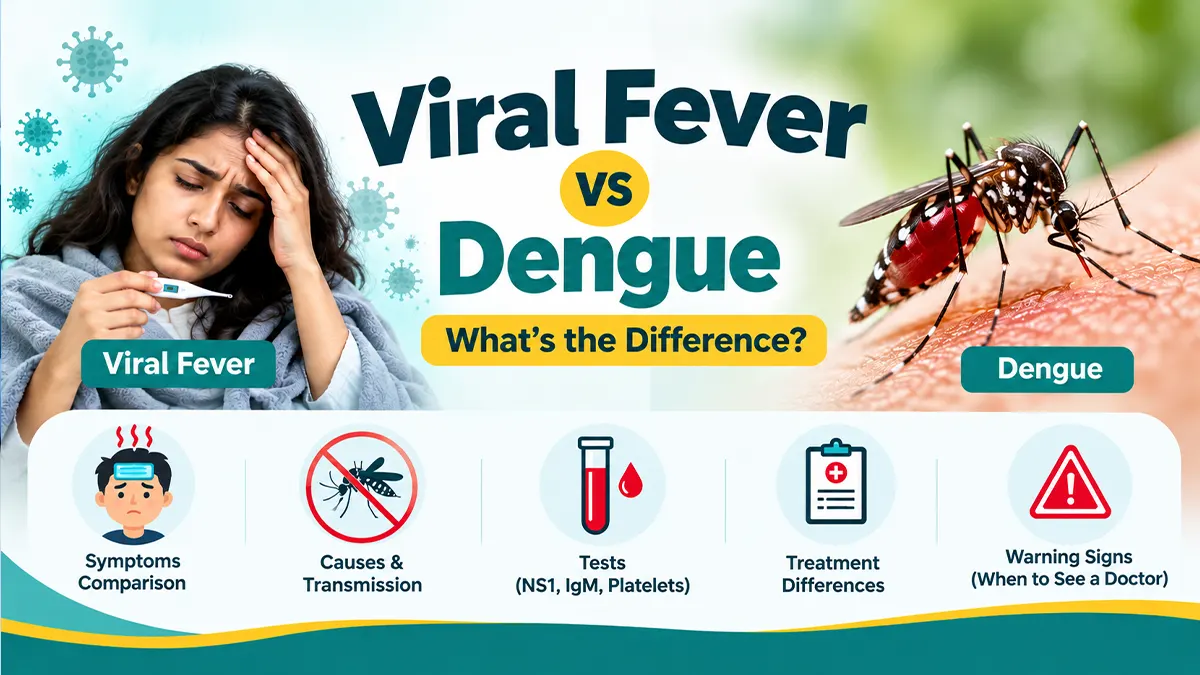
Viral Fever vs Dengue: Key Points
01
Early symptoms overlap
Dengue and other viral illnesses can both begin with fever, headache, tiredness and body aches.
02
Symptoms can give clues
Severe body pain, pain behind the eyes, nausea or rash may raise suspicion for dengue, while cough or sore throat can point toward a respiratory virus.
03
Testing matters
When dengue is suspected, the appropriate test depends on how many days have passed since symptoms began.
What Is the Difference Between Viral Fever and Dengue?
Viral fever is a broad term rather than one specific disease. Different viruses can cause fever and associated symptoms. Dengue is a specific mosquito-borne viral infection caused by dengue virus.
The early phase can be difficult to distinguish clinically. WHO notes that dengue in its febrile phase cannot be reliably differentiated from several other infections on clinical features alone, which is why appropriate testing can be important.
| Feature | Viral illness / respiratory viral fever | Dengue |
|---|---|---|
| Cause | Many different viruses can cause fever. | Dengue virus. |
| Spread | Depends on the virus; respiratory viruses commonly spread through respiratory secretions and close contact. | Usually spread through bites from infected Aedes mosquitoes. |
| Fever | Variable; depends on the virus. | Often high fever, commonly with headache and body aches. |
| Body / joint pain | May occur and is often mild to moderate. | Can be prominent, including muscle, joint or bone pain. |
| Pain behind the eyes | Not a typical feature of most respiratory viral infections. | Commonly reported with dengue. |
| Cough / sore throat / runny nose | Common with respiratory viral infections. | Less characteristic of dengue. |
| Rash | May occur with some viral illnesses. | Can occur with dengue during the illness. |
| Laboratory confirmation | Depends on the suspected virus; some viral illnesses are diagnosed clinically. | Testing may include NS1 antigen, NAAT and/or antibody testing depending on illness day and clinical context. |
This table gives general patterns, not a diagnosis. Symptoms overlap and other infections can cause similar fever.
Want more health information from My Health Hospitals?
Add My Health Hospitals as a Preferred Source on Google to make it easier to see more of our health content in relevant Google Search experiences.
Viral Fever Symptoms
Because “viral fever” can refer to many different viral infections, symptoms vary. A respiratory viral infection may include:
- Fever or chills
- Cough
- Sore throat
- Runny or blocked nose
- Headache
- Body aches
- Fatigue
- Reduced appetite
Do not assume “viral fever” means dengue is excluded.
If fever is persistent, symptoms become more severe, there is relevant mosquito exposure or there are dengue warning signs, seek medical evaluation.
Dengue Symptoms: What to Look For
WHO and CDC describe dengue symptoms such as fever, headache, pain behind the eyes, muscle and joint pain, nausea or vomiting and rash. Symptoms may be mild or severe, and some people have no symptoms.
01
High fever
Fever is a common feature, often accompanied by other systemic symptoms.
02
Headache
Headache may be prominent, sometimes with pain behind the eyes.
03
Muscle & joint pain
Marked aches and pains can occur during dengue.
04
Nausea or vomiting
Digestive symptoms may accompany the fever.
05
Rash
A rash may develop during the illness in some patients.
06
Fatigue
Weakness and tiredness can continue during and after the acute illness.
Dengue Warning Signs: Do Not Wait
Warning signs can develop when the fever is falling, so a lower temperature does not automatically mean the illness is improving safely. Severe abdominal pain or tenderness, persistent vomiting, bleeding, rapid breathing, marked fatigue or restlessness and other severe symptoms require immediate medical care.
- Severe abdominal pain or tenderness
- Repeated or persistent vomiting
- Bleeding from the nose or gums
- Vomiting blood or blood in the stool
- Rapid breathing or difficulty breathing
- Extreme weakness, marked restlessness or unusual sleepiness
- Pale, cold or clammy skin or other signs of circulatory problems
When Should You Get a Dengue Test?
Testing is most useful when the clinician has reason to suspect dengue based on the illness pattern, exposure and local epidemiology. During the first 7 days, CDC recommends combinations such as NS1 antigen with IgM or NAAT with IgM; after day 7, IgM becomes the primary serologic test.
DAYS 0–7
Acute phase testing
NS1 antigen or a molecular NAAT may help detect dengue during the acute phase. IgM is often used alongside the acute test.
AROUND DAY 4–7
IgM becomes more useful
IgM antibodies typically become detectable around 4–5 days after symptom onset, although timing and test performance vary.
AFTER DAY 7
Later-phase testing
IgM becomes the main serologic test in CDC guidance, with interpretation based on the overall clinical situation and prior results.
A negative early test does not always rule out dengue.
A negative NS1 or NAAT result during the acute phase does not by itself exclude dengue when clinical suspicion remains.
What About Platelets in Dengue?
A complete blood count (CBC) may be used to monitor the blood picture during suspected or confirmed dengue. A falling platelet count can occur, but platelet count alone does not confirm dengue and should not be used as the only measure of disease severity.
Clinical condition, hydration, hematocrit trends, bleeding, warning signs and other laboratory findings all matter. India’s national dengue guideline recommends clinical follow-up and CBC/hematocrit monitoring according to the patient’s condition.
How Are Viral Fever and Dengue Treated?
There is no single treatment for every “viral fever.” Management depends on the underlying infection and the patient's severity. Dengue has no specific antiviral treatment, so care is mainly supportive.
For uncomplicated viral illness
- Rest and adequate fluids
- Fever and pain relief when appropriate
- Monitor for worsening or new symptoms
- Avoid unnecessary antibiotics because they do not treat viral infections
For suspected or confirmed dengue
- Rest and appropriate oral fluids when tolerated
- Paracetamol for fever or pain when medically appropriate
- Avoid aspirin and NSAIDs such as ibuprofen because of bleeding risk
- Clinical review and monitoring when symptoms or warning signs warrant it
Medicines to Avoid When Dengue Is Possible
Avoid aspirin and NSAIDs such as ibuprofen when dengue is suspected unless a clinician specifically advises otherwise.
Paracetamol is commonly recommended for fever and pain in dengue.
Do not self-start antibiotics just because a fever has lasted several days. Antibiotics treat selected bacterial infections, not dengue and not most viral illnesses.
Can Viral Fever Turn Into Dengue?
No. Dengue is a separate infection caused by dengue virus. What can happen is that early dengue is mistaken for an unspecified viral fever because the symptoms overlap during the first few days. The diagnosis may become clearer with the clinical course and appropriate testing.
Fever During Monsoon in Hyderabad: Why Testing May Matter
During periods of local dengue transmission, clinicians may have a lower threshold to consider dengue in a patient with compatible symptoms and mosquito exposure. However, monsoon fever is not synonymous with dengue: malaria, chikungunya, respiratory viruses, typhoid and other illnesses can also cause fever.
My Health Hospitals' General Medicine content describes fever as a symptom with multiple possible causes and recommends targeted testing based on the clinical picture rather than relying on temperature alone.
When Should You Go to the Hospital?
Seek urgent medical care if fever is accompanied by warning signs, significant dehydration, breathing difficulty, confusion, fainting, severe pain or unusual bleeding.
Fever that is persistent or getting worse deserves assessment
If you are unsure whether the illness is dengue, another viral infection or a different cause of fever, a physician can assess the symptoms and decide which tests are appropriate.
Fever Care in HyderabadMEDICAL REVIEWGeneral Medicine

Dr. Ch. Srujith
MBBS, MD — General Physician & Diabetologist
Viral Fever vs Dengue – Frequently Asked Questions
You often cannot reliably distinguish them from symptoms alone during the first few days. Dengue may cause high fever, headache, pain behind the eyes, muscle or joint pain, nausea or rash, while a respiratory viral illness is more likely to cause cough, sore throat or runny nose. Testing may be needed when dengue is suspected.
Viral fever is a broad term for fever caused by a viral infection, whereas dengue is a specific infection caused by dengue virus and spread by infected Aedes mosquitoes. Their early symptoms can overlap, so the clinical pattern and appropriate testing are important.
Yes. Early dengue can resemble other viral illnesses, with fever, headache, body aches and fatigue. Dengue cannot be ruled out simply because the symptoms initially look like a common viral infection.
Common dengue symptoms include fever, headache, pain behind the eyes, muscle and joint pain, nausea or vomiting and sometimes a rash. Some people have mild or no symptoms.
Cough, sore throat, runny or blocked nose and other respiratory symptoms are more suggestive of a respiratory viral infection. However, symptoms overlap with many illnesses, so they do not by themselves exclude dengue or other infections.
Testing should be considered when dengue is clinically suspected, particularly during the first week of illness or when fever is accompanied by severe body pain, headache, pain behind the eyes, nausea, vomiting or rash, or when there is relevant mosquito exposure or local dengue activity.
During the first 7 days of illness, healthcare professionals may use a dengue NS1 antigen test together with an IgM antibody test, or a molecular NAAT such as RT-PCR with IgM, depending on the clinical setting. A negative early test does not always rule out dengue.
Dengue IgM can become detectable around 4 to 5 days after symptom onset. After the first week, IgM becomes the primary serologic test in CDC guidance, although the exact testing strategy depends on the clinical situation.
No. A low platelet count can occur in dengue and is useful for monitoring, but platelet count alone does not confirm dengue. Diagnosis requires the overall clinical picture and appropriate laboratory testing.
Some viral and other infections can affect blood counts, so a low platelet count is not specific to dengue. The result should be interpreted with symptoms, examination findings and other tests.
Treatment depends on the cause. For suspected dengue, paracetamol is generally used for fever and pain, while aspirin and NSAIDs such as ibuprofen should be avoided because of bleeding risk. Antibiotics do not treat viral infections unless a separate bacterial infection is diagnosed.
For mild illness, maintain adequate oral fluids as tolerated. Water, oral rehydration solutions and other appropriate fluids can help prevent dehydration. People with vomiting, poor oral intake or warning signs may need medical assessment and supervised fluid management.
Dengue symptoms commonly last about 2 to 7 days. A critical phase can occur around the time the fever falls, so improving temperature does not always mean the illness is fully safe or over.
The duration depends on the virus. Many uncomplicated viral infections improve over several days, but persistent, worsening or unusually severe fever needs medical evaluation rather than assuming it is a routine viral illness.
When dengue is possible, ibuprofen and other NSAIDs should be avoided because they can increase bleeding risk. Paracetamol is generally preferred for fever and pain, using the dose advised by a healthcare professional or product instructions.
Paracetamol is commonly used to control fever and pain in dengue. Use the recommended dose and avoid taking more than one medicine containing paracetamol at the same time unless a clinician advises it.
Yes. Warning signs can develop around or after the time fever decreases. Severe abdominal pain, repeated vomiting, bleeding, breathing difficulty, marked weakness, restlessness or unusual sleepiness require immediate medical assessment.
Warning signs include severe abdominal pain or tenderness, persistent or repeated vomiting, bleeding from the nose or gums, vomiting blood or blood in the stool, rapid breathing, extreme tiredness or restlessness, and other signs of circulatory or organ problems. Severe dengue is a medical emergency.
A dengue blood test can help confirm dengue when the appropriate test is positive. Other blood tests, including a CBC, can help assess illness and monitor complications, but no single routine blood count can identify every viral cause.
Arrange a medical assessment, especially in an area where dengue is circulating or after mosquito exposure. A clinician may consider dengue, malaria, influenza, chikungunya, typhoid and other causes based on symptoms, examination and local epidemiology.
Latest Health Blogs
Expert-written medical articles from My Health Hospitals



Our Branch Locations
Find the Best Hospital Near You
My Health Hospitals – Kukatpally
H.No 15-24-212, MIG-212, Rd Number 1, K P H B Phase 1, Kukatpally, Hyderabad, Telangana 500072
My Health Hospitals – Tarnaka
H.No:-12-5-30, WhiteHouse, Moula Ali Rd, South Lalaguda, Tarnaka, Secunderabad, Telangana 500017
My Health Assistant