-
 Kphb Branch
+91 9111674111
-
Tarnaka Branch
+91 9100001201
- Book Appointment
+91 9111674111
+91 9100001201
Cardiology
Medically Reviewed by Dr. Dr. Vijay Soorampally Senior Consultant Cardiologist | My Health Hospitals
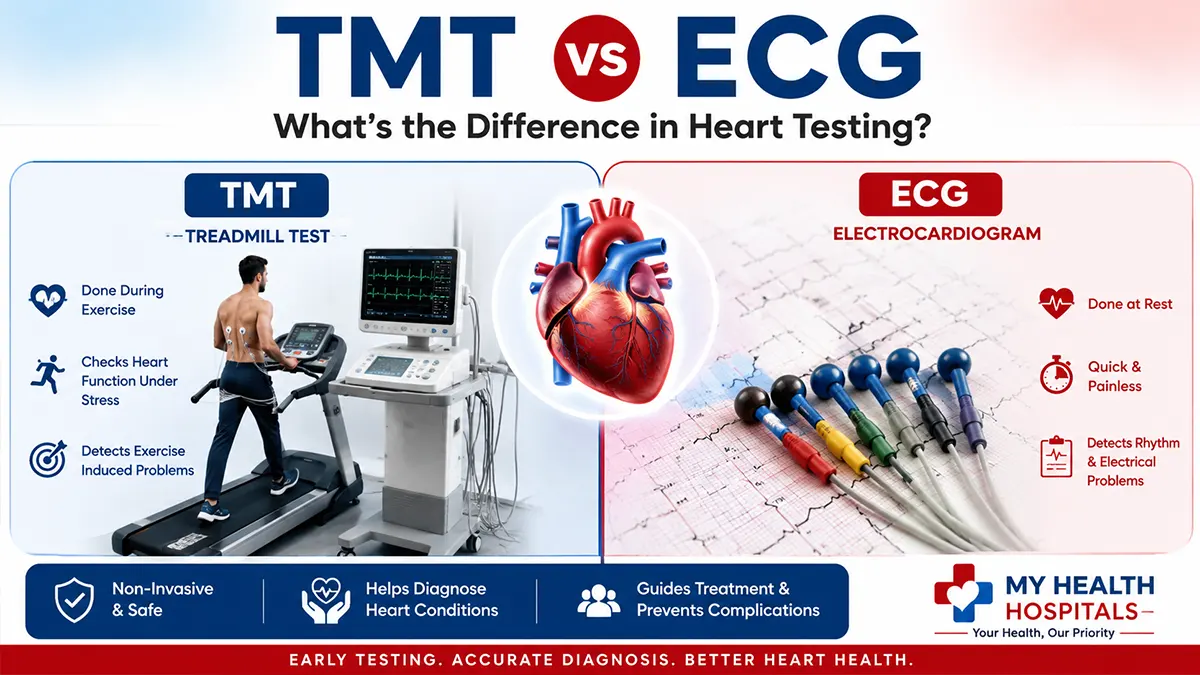
When evaluating heart health, doctors often recommend either an Electrocardiogram (ECG) or a Treadmill Test (TMT). Although both tests assess heart function, they serve different purposes and provide different types of information.
An ECG records the electrical activity of your heart while you are resting, whereas a TMT evaluates how your heart performs during physical exercise. Choosing the right test depends on your symptoms, medical history, risk factors, and your cardiologist's clinical assessment.
Understanding the difference between ECG and TMT helps patients know why one test may be recommended instead of the other and what each examination can reveal about heart health.
An ECG is usually the first-line investigation for chest pain, palpitations, dizziness, and irregular heartbeat. A TMT (Exercise Stress Test) is commonly recommended when doctors need to evaluate blood flow to the heart during physical activity or investigate suspected coronary artery disease.
At My Health Hospitals, our experienced cardiologists use advanced cardiac diagnostics, including ECG, TMT, Echocardiography, Holter Monitoring, and other non-invasive heart tests to accurately diagnose cardiovascular conditions and guide personalized treatment.
An Electrocardiogram (ECG), also called an EKG, is one of the most commonly performed heart tests used to evaluate the electrical activity of the heart. Small adhesive electrodes are placed on the chest, arms, and legs to record electrical signals generated by each heartbeat.
The test is painless, non-invasive, and usually takes less than 10 minutes. It helps cardiologists identify abnormal heart rhythms, previous heart attacks, conduction abnormalities, and other heart-related conditions. Because it records heart activity while you are resting, an ECG is often the first diagnostic test performed when a patient experiences chest pain, dizziness, palpitations, or shortness of breath.
An ECG provides a snapshot of your heart's electrical activity at a specific moment. While it can detect many heart problems, a normal ECG does not always rule out coronary artery disease or exercise-induced heart conditions.
A Treadmill Test (TMT), also known as an Exercise Stress Test, evaluates how your heart performs during physical activity. Unlike an ECG performed at rest, a TMT records the heart's electrical activity while you walk on a treadmill with gradually increasing speed and incline.
Exercise makes the heart work harder and increases its oxygen demand. If there is narrowing or blockage in the coronary arteries, reduced blood flow may produce changes that become visible only during exercise. For this reason, a TMT is particularly useful in evaluating patients with suspected coronary artery disease and exercise-related symptoms.
During the test, your heart rate, blood pressure, ECG changes, and symptoms are continuously monitored by trained healthcare professionals. The test is stopped immediately if significant symptoms or concerning ECG changes occur.
A TMT helps determine how well your heart responds to physical stress. It is commonly used to evaluate exercise-induced chest pain, assess fitness before starting an exercise program, and estimate cardiovascular risk in selected patients.
Although both ECG (Electrocardiogram) and TMT (Treadmill Test) evaluate heart health, they are designed to answer different clinical questions. An ECG records your heart's electrical activity while you are at rest, whereas a TMT assesses how your heart performs during physical exercise. Doctors choose the appropriate test based on your symptoms, medical history, cardiovascular risk factors, and suspected heart condition.
For example, someone experiencing palpitations while resting may first need an ECG. On the other hand, if chest discomfort occurs only during walking or climbing stairs, a TMT may provide more useful information by evaluating the heart under physical stress.
An ECG and a TMT are complementary tests rather than competing tests. In many cases, a cardiologist may recommend both to obtain a more complete assessment of heart function and identify conditions that may not be apparent on a resting ECG alone.
| Feature | ECG (Electrocardiogram) | TMT (Treadmill Test) |
|---|---|---|
| Purpose | Records the heart's electrical activity at rest. | Evaluates heart function during physical exercise. |
| Performed At | Resting state | While walking or running on a treadmill |
| Duration | 5–10 minutes | 20–30 minutes (including preparation and recovery) |
| Detects | Arrhythmias, previous heart attack, conduction abnormalities | Exercise-induced ischemia, coronary artery disease, exercise-related arrhythmias |
| Physical Activity Required | No | Yes |
| Blood Pressure Monitoring | Not routinely during the test | Continuously monitored during exercise |
| Chest Pain Evaluation | Useful for pain occurring at rest | Useful for pain triggered by exertion |
| Preparation | Minimal preparation | Comfortable clothing and exercise readiness required |
| Suitable For | Most patients | Patients able to exercise safely |
| Common Use | Initial cardiac evaluation | Assessment of coronary artery disease and exercise tolerance |
Neither test is universally better—they answer different clinical questions. An ECG is typically the first test performed to evaluate the heart's rhythm and electrical activity at rest. A TMT is recommended when symptoms occur during physical activity or when additional information about exercise-related heart function is needed.
Your cardiologist may recommend one or both tests depending on your symptoms, physical examination, medical history, and cardiovascular risk profile. Choosing the right investigation helps achieve an accurate diagnosis and an appropriate treatment plan.
Both ECG and TMT play important roles in diagnosing heart conditions, but they are recommended for different clinical situations. An ECG is typically the first heart test performed because it is quick, painless, and provides valuable information about the heart's electrical activity at rest. A TMT is usually advised when doctors need to evaluate how the heart responds to physical activity or suspect reduced blood flow to the heart during exercise.
The decision depends on your symptoms, age, medical history, risk factors, and findings from your physical examination. In many cases, your cardiologist may recommend both tests to obtain a more complete picture of your heart health.
Patients with chest pain during physical activity, diabetes, high blood pressure, high cholesterol, smoking history, or a family history of heart disease may require additional cardiac testing beyond a routine ECG.
A resting ECG is often the first diagnostic test used to evaluate symptoms suggestive of heart disease. It helps detect abnormalities that are present even when the patient is not physically active.
A Treadmill Test is recommended when symptoms occur during physical activity or when doctors need to assess the heart under exercise-related stress.
Pain, pressure, or discomfort in the chest during rest or physical activity should always be evaluated promptly.
Difficulty breathing during routine activities may indicate reduced heart function or coronary artery disease.
A sensation of rapid, irregular, or skipped heartbeats should be assessed by a cardiologist.
Frequent dizziness or fainting episodes may indicate an underlying heart rhythm disorder.
Patients with hypertension often require periodic heart evaluations to monitor cardiovascular health.
Individuals with a family history of heart disease may benefit from preventive cardiac screening.
Yes. In many cases, cardiologists recommend both tests because they provide different but complementary information. An ECG evaluates your heart's electrical activity at rest, while a TMT assesses how your heart performs during exercise. Using both tests together can improve diagnostic accuracy, particularly in patients with suspected coronary artery disease or exercise-related symptoms.
The most appropriate heart test depends on your individual symptoms and risk factors. Your cardiologist will determine which investigation—or combination of tests—is best suited to your clinical condition.
Both ECG and TMT are valuable non-invasive cardiac investigations, but neither test is perfect. Understanding their strengths and limitations helps patients appreciate why cardiologists sometimes recommend additional tests such as Echocardiography, Holter Monitoring, CT Coronary Angiography, or Coronary Angiography for a comprehensive evaluation.
An ECG and a TMT should be interpreted alongside your symptoms, physical examination, medical history, and other diagnostic findings. A normal result does not always rule out heart disease, particularly in patients with persistent symptoms or multiple cardiovascular risk factors.
Although a TMT is safe for many individuals when performed under medical supervision, it is not appropriate for everyone. Your cardiologist will carefully review your medical history and current health before recommending the test.
If a TMT is not suitable, your cardiologist may recommend alternative investigations such as stress echocardiography, myocardial perfusion imaging, CT coronary angiography, or other advanced cardiac tests.
If you're experiencing chest pain, shortness of breath, palpitations, dizziness, unexplained fatigue, or high blood pressure, don't delay seeking medical attention. Early diagnosis can help detect heart conditions before they progress and allows timely treatment.
Consult our experienced cardiologists for comprehensive heart evaluation and personalized treatment.
Book Appointment Call Now
MBBS, MD (General Medicine), DM (Cardiology)
Cardiologist & Interventional Cardiologist
Experience: 9+ Years
Consultation Timings: 4:00 PM – 6:00 PM
Dr. Vijay Soorampally specializes in the diagnosis and treatment of coronary artery disease, hypertension, heart failure, arrhythmias, preventive cardiology, and minimally invasive interventional cardiology procedures. He is committed to evidence-based cardiac care and personalized treatment plans to help patients achieve better heart health.
This article is intended for educational purposes only and should not replace professional medical advice, diagnosis, or treatment. If you experience chest pain, shortness of breath, dizziness, palpitations, or any symptoms suggestive of heart disease, consult a qualified cardiologist promptly for a comprehensive evaluation and personalized treatment.
Expert-written medical articles from My Health Hospital
Find the Best Hospital Near You
H.No 15-24-212, MIG-212, Rd Number 1, K P H B Phase 1, Kukatpally, Hyderabad, Telangana 500072
H.No:-12-5-30, WhiteHouse, Moula Ali Rd, South Lalaguda, Tarnaka, Secunderabad, Telangana 500017